
The AI ‘Redundancy’ Playbook: A Banker’s 3-Tier Financial Defense for a Changing Job Market

Last Tuesday, a client sat in my office—a sharp, successful marketing director in her early 30s. For the first time in our years of working together, she wasn’t worried about market volatility or her investment returns. She was worried about becoming obsolete.
“I’ve spent a decade becoming an expert in my field,” she said, a line of genuine concern etched on her face. “Now I see AI tools doing in ten minutes what used to take me ten hours. Am I going to be ‘optimized’ out of a job?”
This is the new, quiet anxiety I hear every single day from even my most successful clients. The fear isn’t about a recession in the traditional sense; it’s about a fundamental rewiring of the job market itself. And they’re right to be concerned. Analysts project that by 2026, a significant portion of traditional job roles will involve collaboration with AI agents, redefining what it means to be a valuable professional.
Throughout my banking career, I’ve studied the patterns of past downturns and actively navigated clients through the 2020 pandemic shock. The advice then was largely defensive: cut spending, build your emergency fund, and wait for the jobs to come back.
But here’s the crucial difference in 2026: The jobs being displaced by AI may not be coming back in the same form. This isn’t a cyclical storm to wait out; it’s a permanent climate change. The old playbook is broken. You need a new one.
This is the AI Redundancy Playbook—a 3-Tier Financial Defense I’m building with my clients to turn this anxiety into an actionable, empowering strategy.

Tier 1: The ‘Career Fortress’ (Your Proactive Offense)
The old model of job security was loyalty. The new model is adaptability. Your greatest financial asset isn’t your 401(k); it’s your ability to earn an income. In the age of AI, you must actively protect and enhance that asset. This is no longer optional.
This means investing in the one thing AI can’t replicate: uniquely human skills. While technical skills are important, traits like analytical thinking, creative problem-solving, and emotional intelligence are becoming the true differentiators.
Your Action Plan:
- Become an “AI Collaborator,” Not a Competitor: A graphic designer I know feared AI image generators would replace her. Instead, she mastered using them for initial concepts, then applied her human creativity to refine and add emotional depth. Her income doubled because she could deliver faster while maintaining the human touch clients craved. Don’t run from the tools; learn to pilot them.
- Stack Your Skills: Layer a high-demand skill onto your existing expertise. If you’re a great writer, learn SEO and data analytics. If you’re a project manager, get a certification in a new software platform. This makes you a hybrid talent—far harder to replace than a specialist.
- Build Your Personal Brand: Actively share your industry insights on platforms like LinkedIn. Your network is one of your most powerful career assets. A strong personal brand ensures that recruiters and opportunities find you, even when you aren’t looking.
“In past downturns, the goal was to simply hold onto your job. In the 2026 AI shift, the goal is to make your skills so valuable that any job would be lucky to have you.”

Tier 2: The ‘F.U. Money’ Fund (Your Strategic Defense)
Let’s be clear: this is NOT your standard emergency fund. An emergency fund is for when your car breaks down. An ‘F.U. Money’ fund is for when your career breaks down. It’s the ultimate financial power move. It’s a cash reserve large enough to give you the freedom to say “F.U.” to a toxic job, a diminishing role, or a surprise layoff, all without panicking.
This fund is your runway. It buys you time—time to retrain, time to find the right next role instead of the first available one, or even time to launch your own venture.
Your Action Plan:
- Calculate Your Number: This isn’t just 3-6 months of bare-bones survival expenses. Aim for 6 to 12 months of your full current living expenses. This ensures you can maintain your life and network without stress. If your monthly expenses are $5,000, your target is $30,000 to $60,000.
- Park It Smartly: This money needs to be safe and liquid, but it shouldn’t be losing value to inflation in a traditional savings account. A High-Yield Savings Account (HYSA) is the perfect home for it.
- Automate and Forget: Set up an automatic weekly or bi-weekly transfer into this account. Treat it like a non-negotiable bill you pay to your future self.
“An emergency fund helps you survive a layoff. An ‘F.U. Money’ fund gives you the power to initiate one on your own terms.”
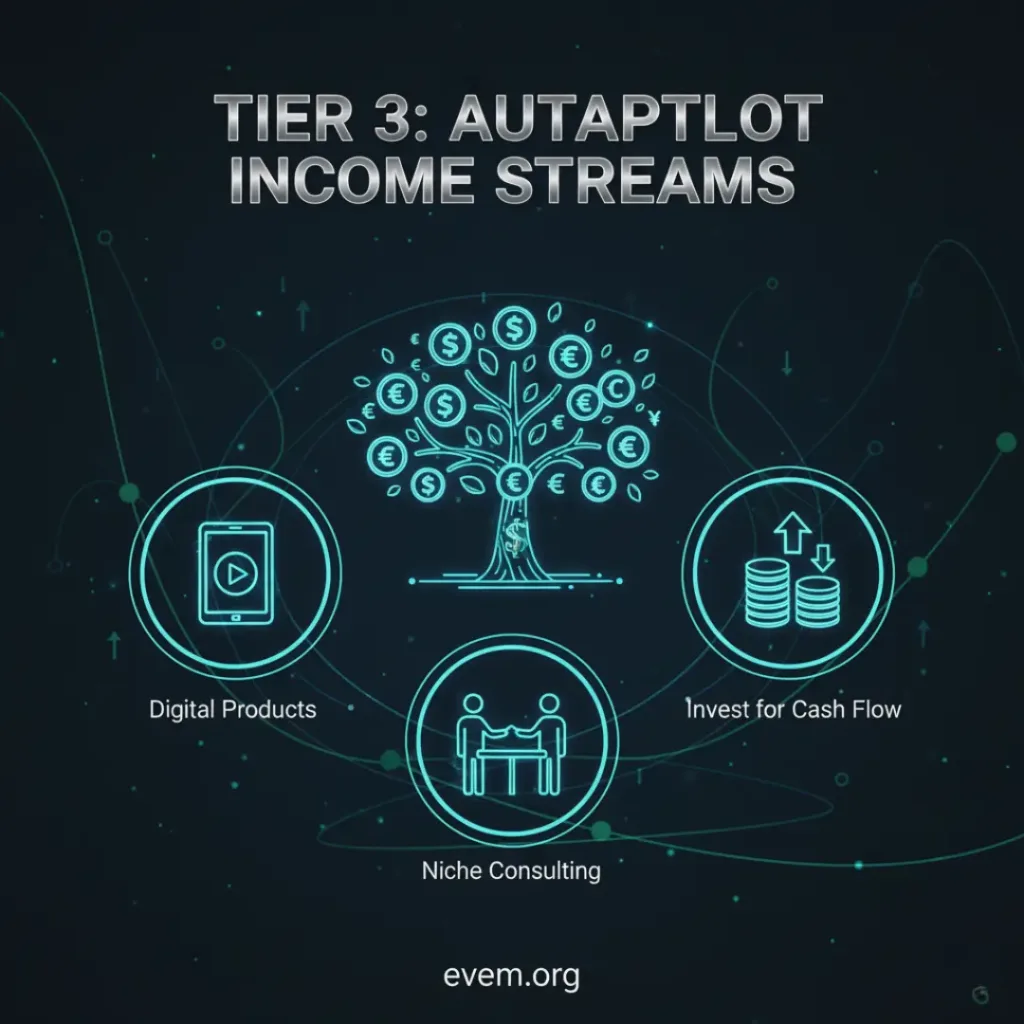
Tier 3: ‘Autopilot’ Income Streams (Your Financial Diversification)
Relying on a single paycheck from one employer is the financial equivalent of standing on a three-legged stool with one leg showing cracks. To build true resilience, you need to diversify your income sources. The goal isn’t to become a burned-out “hustle culture” fanatic; it’s to build semi-passive streams that reduce your dependency on a 9-to-5.
Your Action Plan:
- Monetize Your Expertise (Digitally): You already have a valuable skill that got you your primary job. Package it. Create a small digital product—an ebook, a set of templates, a short video course—that solves a specific problem for people in your industry.
- Niche Consulting: Offer your core skill as a consultant for 1-2 small clients. This not only provides a second income stream but also keeps your skills sharp and your network active, acting as a form of career cushioning.
- Invest for Cash Flow: This is the most passive option. As you build your savings, deploy capital into dividend-paying ETFs. This creates a small but growing stream of income that arrives every quarter, completely independent of your employment status.
Turning Fear into a Financial Fortress
The rise of AI doesn’t have to be a source of anxiety. It can be the ultimate catalyst for taking control of your financial destiny. The professionals who will thrive in 2026 and beyond are not the ones burying their heads in the sand, but those who are building their financial fortress, brick by brick.
By developing an offensive career strategy, a powerful defensive cash position, and a diversified set of income streams, you’re not just preparing for a potential job loss. You are engineering a future where you are no longer dependent on any single job for your security and freedom. And that is a future worth building.
Join our email list and get access to exclusive content available only to subscribers.